The founder · Haji Osman Adam · 1885–1914
The first thread: Haji Osman Adam.
Before the Gaffar household came to Nyasaland in 1925, the family’s story reaches back to Haji Osman Adam, a Memon merchant from Gujarat who arrived in Africa in 1885 and built a trading house that carried his name across three territories.
The family calls him its founder. This page sets out what the public record documents and what the family record now names: five generations from Haji Osman Adam to Adam and Aziz.
Haji Osman Adam was born at Sadargut, in Gujarat. His family later settled at Lalpur, in the State of Jamnagar. He was a Memon Muslim merchant, and he came to Africa in 1885 — the year the family gives for the beginning of its African story.
He did not arrive in Nyasaland directly. His first ports were Quelimane and Chinde, on the Portuguese East African coast. From there the old trade route ran up the Zambezi and the Shire to Chiromo, at the head of navigation, and on to Blantyre. That is the route he took.
The store he built in Blantyre became the family’s first landmark in the country: a general merchant’s business, a name on a shopfront, and the beginning of a commercial house that would outlast him.
1885–1914
From the coast to Blantyre.
The firm’s geography is the story: an Indian Ocean merchant route that ended in a Blantyre shop, and then reached back out across three territories.
1885 and 1887–1914 from the 1940 South African Indian Who’s Who; 1894 from the Rhodesian Study Circle and Blantyre local history. The 1894 date often given for the firm is the Blantyre store, not its first day.
1894
A general merchant’s store, and a first in Blantyre.
A general merchant in 1890s Nyasaland sold widely and arranged much else besides. Cloth, groceries, salt, sugar and imported household goods sat alongside credit, transport and the next shipment from the coast. The store was a shop, a warehouse and a point of contact between the Indian Ocean trade and the growing town.
Osman Adam’s business began at Chiromo in 1887. In July 1894 he bought a quarter-hectare plot in Blantyre from the Pettittis estate and built his trading store on it. Local Blantyre history records him as the first Indian to buy land in the town. The store that carried his name stood at the beginning of the Indian commercial quarter that would shape the town centre.
The firm’s head office moved to Blantyre in 1910. By then the shop had become a merchant house, and the house had begun to reach beyond Nyasaland.
1887–1937
The firm in its own hand.
The record is not only in directories. The firm’s own stationery, its shop sign and the building it occupied survive — and they show the reach of the business from Blantyre to Bombay and Manchester.
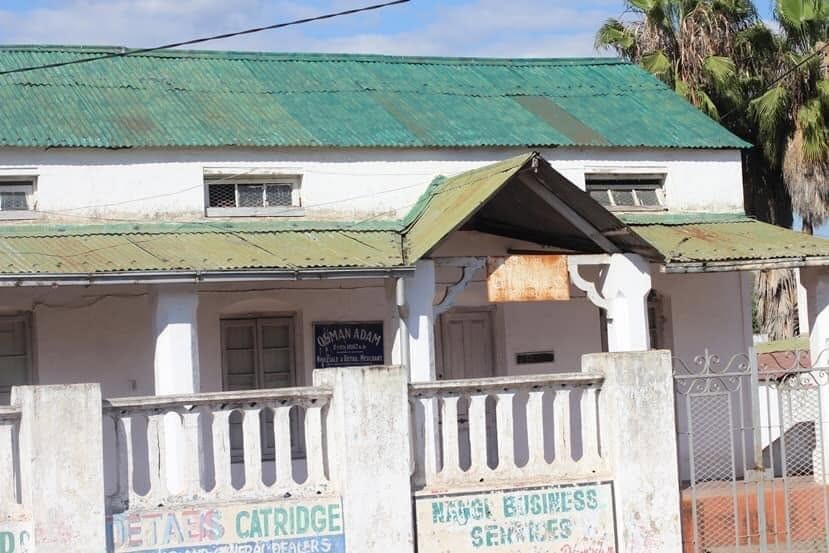
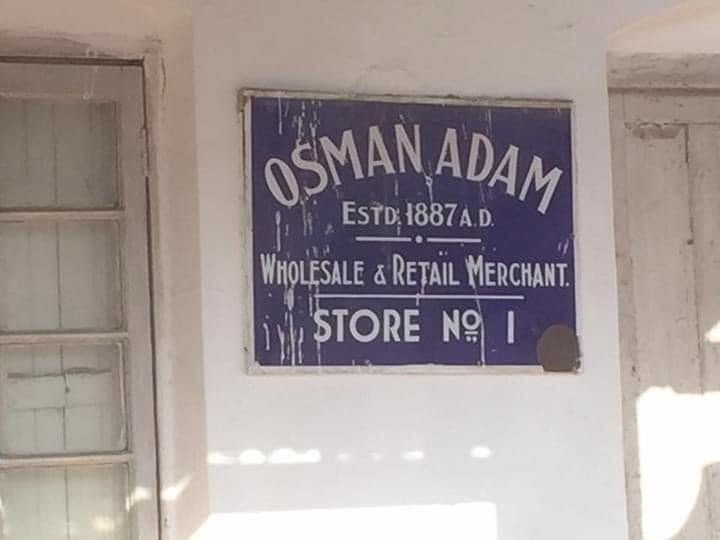
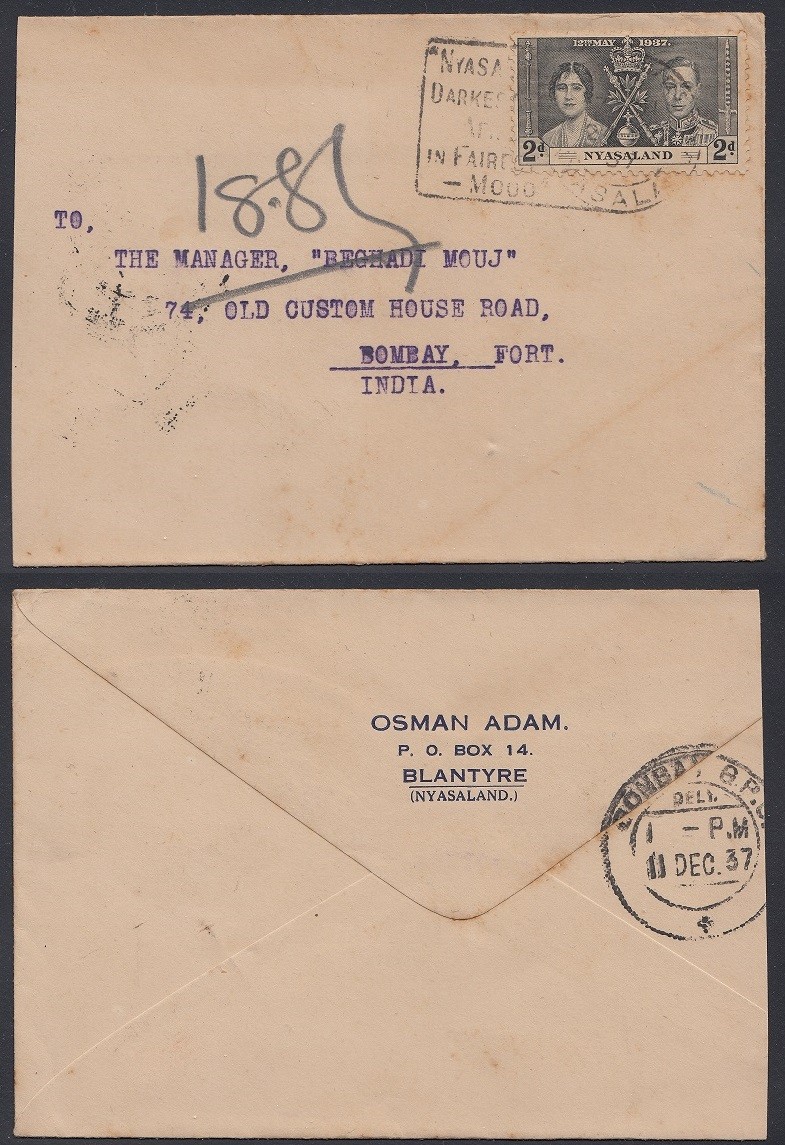
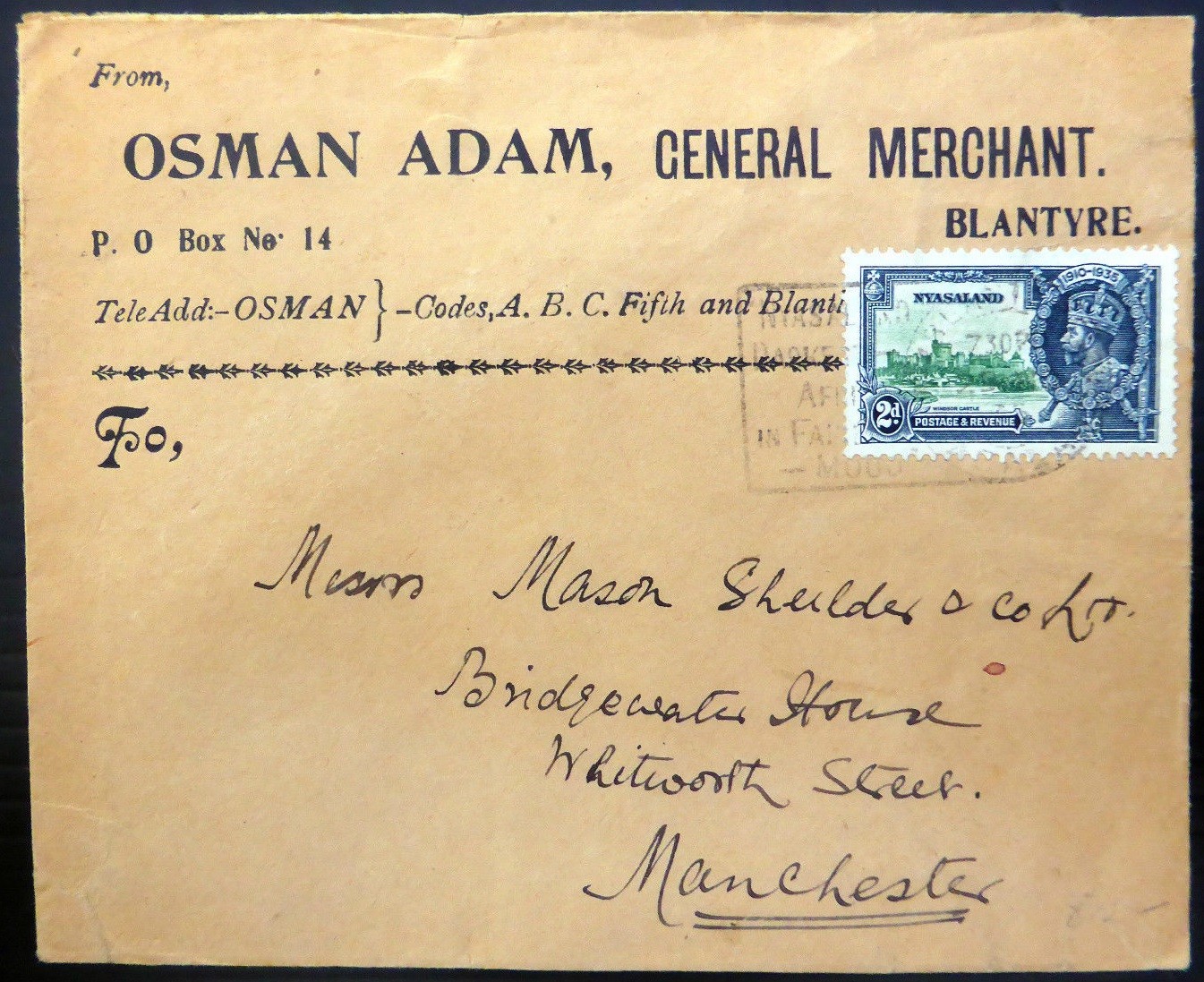
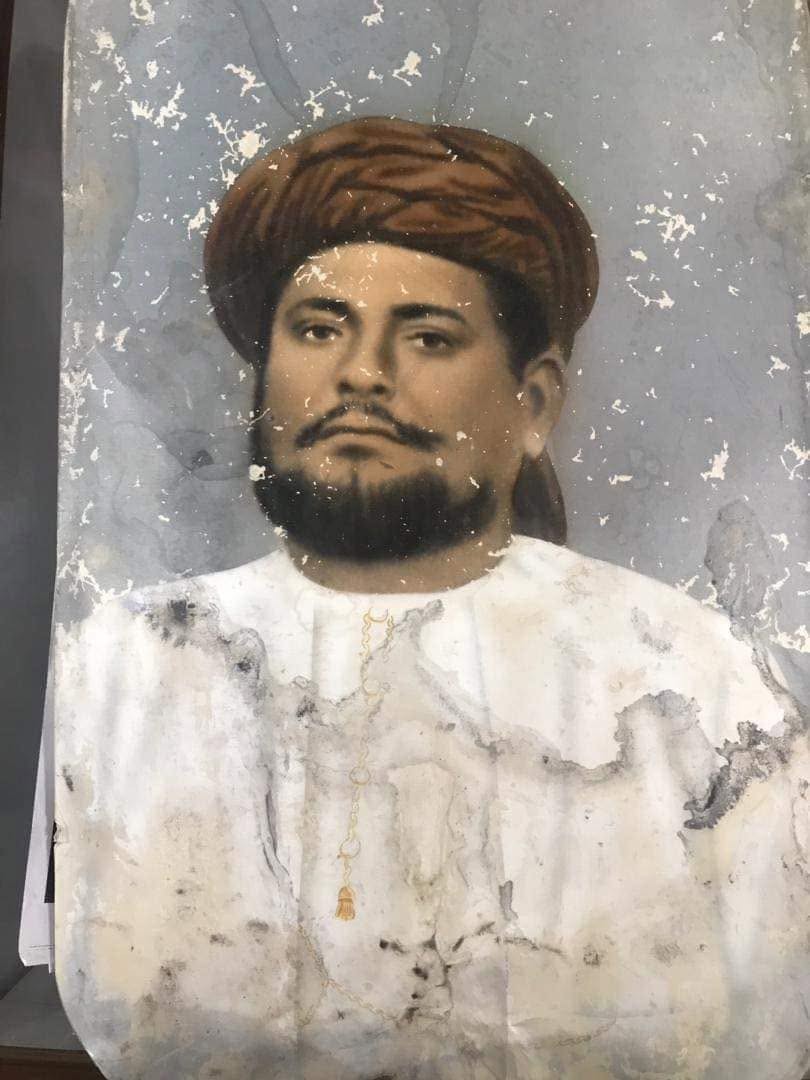
The two envelopes are dated 1935 and 1937 — more than twenty years after Haji Osman Adam’s death — and show the firm still trading under his name. The portrait, store photograph and sign are family-supplied visual records; the envelopes are philatelic records.
1910–1914
A merchant house across three territories.
By 1910 the business had a head office in Blantyre and branches reaching through British Central Africa, Portuguese East Africa and Northern Rhodesia.
Haji Osman Adam built a network rather than a single shop. Goods came in through the coast, moved up the river and the new roads, and were sold through branches and agents across the three territories. The 1940 South African Indian Who’s Who describes the firm as “a prosperous and large business” with “ramifications extending to all parts of British Central Africa, Portuguese East Africa and Northern Rhodesia.” It calls him one of the biggest Muslim merchant businessmen in the area.
He died in 1914. Trustees controlled the business for thirteen years; in 1927 his son Jusab Osman took over, with a brother as joint proprietor. The firm continued, and the family’s commercial life in Blantyre continued with it.
The 1940 directory also remembers his charitable building: a musafarkhana — a rest house for travellers — at Lalpur, for Muslims and Hindus alike, and other charitable institutions. The merchant’s name was not only on a shop.
The first Indian primary school in Blantyre opened in 1938 with initial funds from C.K. Dharap and Haji Osman Adam. Haji Osman Adam had died twenty-four years earlier; the contribution came through his estate or the firm that carried his name. It is a legacy he did not see open.
The name survives. The Rhodesian Study Circle records that the business continues, and Osman Adam Ltd is still listed in Blantyre. The shop became a house; the house became a name that outlasted its founder.
family record
The line, as the family records it.
The family record supplied in November 2026 sets out five generations from Haji Osman Adam to Adam and Aziz. It is a family record, not a public genealogy; the public register confirms the later names, not the parentage.
- Haji Osman Adam Born at Sadargut, in Gujarat; family later at Lalpur. Arrived in Africa in 1885; the Blantyre store dates from 1894. Died in 1914. Public record · birth year to confirm
- Nurmahomed Seth The family’s second generation and the first name in the Gaffar–Seth line. Birth date to confirm. Family record · dates to confirm
- Abdul Gaffar Nurmahomed Seth The family’s third generation and father of Adil Gaffar. Birth date to confirm. Family record · dates to confirm
- Adil Gaffar Companies House records Adil Abdul Gaffar as a designated member of Gaffar Family Holdings and Maravi Caffe Holdings. The family identifies him as the father of Afshar and Abdul Aziz. He built the family’s relationship with Malawian coffee growers. Companies House · parentage from family record
- Afshar Adil Gaffar (Adam) Family name Adam; uses Adam Gaffar in daily life. Married to Mahin Omar, born in Canada on 14 January 1994. They have a young son and daughter. Companies House records his December 1988 birth and her January 1994 birth. Family record · Companies House month
- Abdul Aziz Adil Gaffar (Aziz) Companies House records Abdul Gaffar Aziz Adil Gaffar (February 1997). He builds the Maravi coffee business in Blantyre with Adam and takes it to Britain. Companies House · parentage from family record
What the record says.
The founder’s page is built from four kinds of evidence: a 1940 biographical directory, a specialist philatelic and historical society, local Blantyre history, and the family’s own archive of portraits, stationery and the surviving shop. Where they disagree, the page says so.
| Source | What it supports | Link |
|---|---|---|
| The South African Indian Who’s Who (1940), “Osman Adam Family” | Birth at Sadargut; Lalpur; 1885; Quelimane and Chinde; the 1887 Chiromo business; the 1910 move to Blantyre; the 1914 death; the firm’s reach across the three territories; the Lalpur rest house. | Read the directory ↗ |
| Family record — supplied by the family, 14 November 2026 | The line from Haji Osman Adam to Nurmahomed Seth, Abdul Gaffar Nurmahomed Seth, Adil Gaffar and the brothers; the 1925 household marker; the birth dates of Adil, Adam, Aziz and Mahin. | Family record; no public genealogy located |
| Rhodesian Study Circle, “Osman Adam Ltd” | 1885 arrival; 1894 general merchant’s store; first Indian businessman in Nyasaland; stores across the three territories; death in 1914. | Read the entry ↗ |
| Blantyre local history, including the Maravi Post’s short history of the city | The July 1894 land purchase from the Pettittis estate; the quarter-hectare plot; the trading store; the “first Indian” claim. | Read the local history ↗ |
| Family archive — portrait, store photograph, shop sign and two envelopes | The portrait of Haji Osman Adam; the surviving store and its “Store No. 1” sign; the firm’s 1887 date on the sign; the P.O. Box 14 stationery and the 1935/1937 envelopes to Manchester and Bombay. | Supplied by the family, 13 November 2026 |
| Joey Power, “Race, Class, Ethnicity, and Anglo-Indian Trade Rivalry in Colonial Malawi, 1910–1945” | The first Indian school in Blantyre opened in 1938 with initial funds from C.K. Dharap and Haji Osman Adam; context for the Indian trading quarter and Haji Osman Adam’s place in Blantyre’s commercial life. | Read the article record ↗ |
| Info-clipper, “Osman Adam Ltd, Blantyre” | The company is still listed in Malawi, at St. Lower Sclatter Road, Blantyre. | Read the listing ↗ |
School: supported by Joey Power’s 1993 article, which records the first Indian school in Blantyre opening in 1938 with initial funds from C.K. Dharap and Haji Osman Adam. Because Haji Osman Adam died in 1914, the contribution came through his estate or firm; the page says so rather than implying he opened it himself.
Associations: the Rhodesian Study Circle calls him a founding member of the Nyasaland Indian Traders Association and a one-time leader of the Nyasaland Indian Association. The dated record places the NIA in 1922 and the NITA in 1923 — after his 1914 death. The claim is therefore not published as fact until a dated source resolves the contradiction; it may refer to an earlier association or to a son.
Business: the Rhodesian Study Circle says the business survives, and Osman Adam Ltd is still listed in Blantyre. “Still listed” is the careful form; the site does not claim current trading figures.