The Plates · A photographic structure
Photographs, given a proper frame.
The family has the evidence: buildings as found and finished, rooms, counters, bread, bags, beans, the people who made it. This page sets out how those photographs will sit — the formats, the captions and the order of the argument.
Most frames here are designed slots, numbered and captioned, ready to be replaced. The founder archive is the first real material: the portrait, the surviving store and sign, and two envelopes are now in place.
How a plate works.
A plate is not a picture dropped into a page. It is a numbered piece of evidence with four parts: the frame, the number, the title and the metadata line.
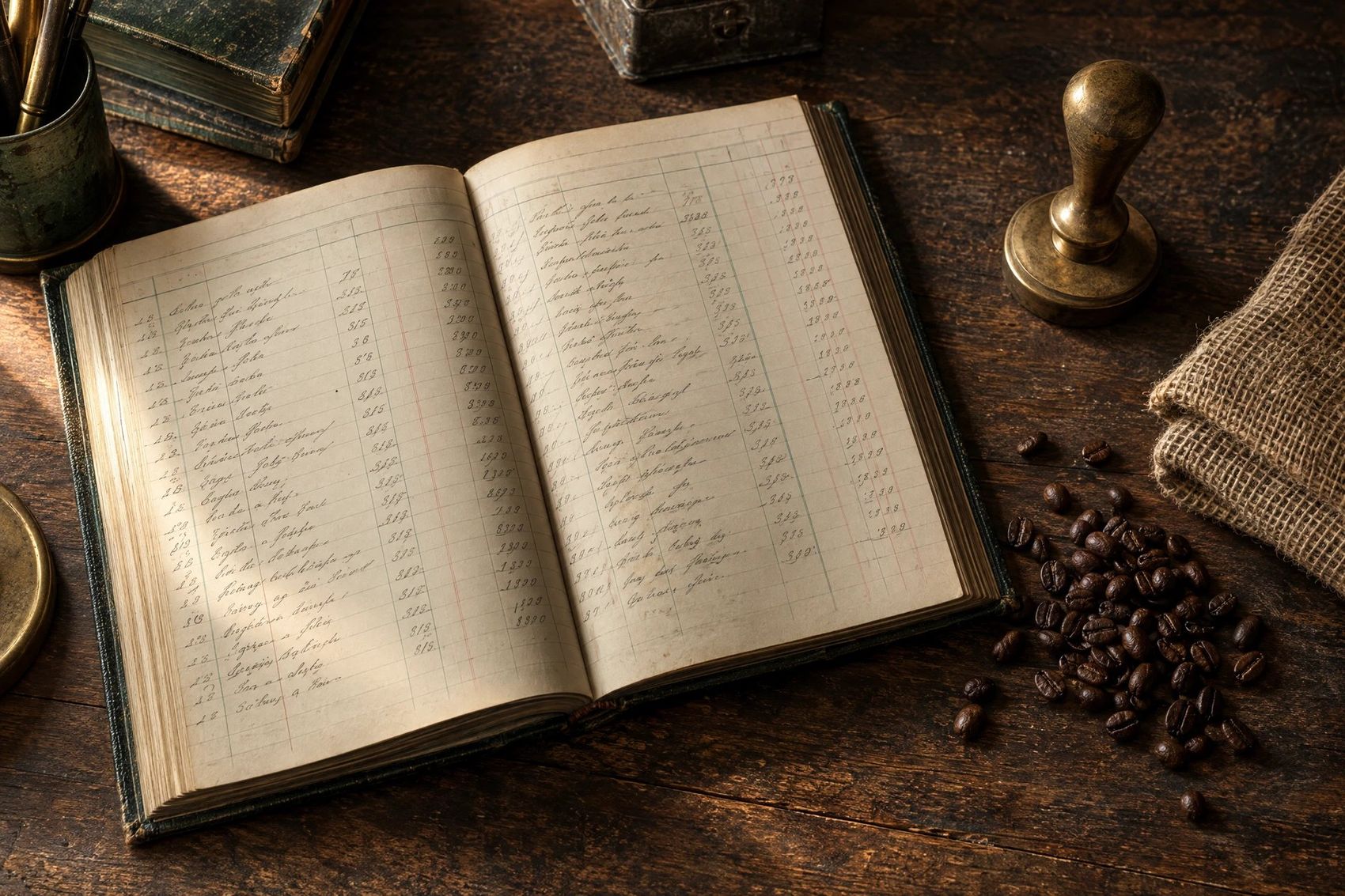
- 01The frame. One consistent crop per role. Landscape for rooms, portrait for people, square for products. The frame is fixed before the photograph is taken.
- 02The number. Plates run in narrative order, not upload order. The number stays with the image wherever it appears.
- 03The title. A plain description, in the family’s voice. “The bread wall, Maravi Bakery.” Not “Artisan baking excellence”.
- 04The metadata. Place · year · format. If the year is unknown, it says “date to confirm” rather than guessing.
Five formats, one rhythm.
The site uses five working formats. Each has a job. Keeping to them is what makes a collection of photographs look like an archive rather than a feed.
Full-bleed · 21:9
One image, edge to edge, for a change of chapter: the coffee country, the warehouse, a room that deserves the whole width of the page. Used sparingly — twice in the whole site.
Inset · 4:5
A small archival portrait or detail set into the text column, so a long chapter has a face in it. Caption below, never over the image.
and after
The argument, made by two photographs.
Nothing the group owns is more persuasive than the building as found beside the room as finished. The site gives each pair a draggable divider, one caption and one rule: same viewpoint, same lens, same time of day.
Drag the handle to compare. With real photographs in place, this is the most powerful element on the site.
Eighteen plates, plus the founder archive.
This is the brief. It tells the family what to photograph, in what format, and where each image will appear. Plates marked “needed” are the priority; the rest are optional.
| Plate | Subject | Place / year | Format | Appears on | Status |
|---|---|---|---|---|---|
| 00 | Haji Osman Adam, the founder | Family portrait · supplied by the family · date to confirm | 4:5 | Founder · Home | Supplied |
| 00A | The Osman Adam store, Blantyre | Surviving building · photographed in recent years | 3:2 | Founder dossier | Supplied |
| 00B | The firm’s “Store No. 1” sign | Blantyre · “Estd. 1887 A.D.” | 3:2 | Founder dossier | Supplied |
| 00C | Osman Adam envelope to Bombay | Blantyre to Bombay · franked 11 December 1937 | 3:4 | Founder dossier | Supplied |
| 00D | Osman Adam envelope to Manchester | Blantyre to Manchester · 1935 | 4:3 | Founder dossier | Supplied |
| 00E | Osman Adam family group | Family archive · names and date to confirm | 4:5 | Founder dossier | Needed |
| 01 | The warehouse: hessian sacks, raking light | Malawi · date tbc | 4:5 | Home | Illustrative |
| 02 | The Gaffar–Seth generations, c. 1900–1950 | Family archive · dates to confirm | 4:5 | Story | Needed |
| 03 | Coffee in the Malawi highlands | Malawi · date tbc | 3:2 | The Dream | Illustrative |
| 04 | Millie’s Artisan, as found | Blantyre · 2019 | 3:2 | Story · Plates | Needed |
| 05 | Millie’s Artisan, finished | Blantyre · 2019 | 3:2 | Story · Plates | Needed |
| 06 | The bread wall, Maravi Bakery | Lilongwe · 2020 | 3:2 | Home · Story | Needed |
| 07 | Maravi Gardens, under the trees | Lilongwe · 2021 | 3:2 | Story · Plates | Needed |
| 08 | Retail bags and supermarket packaging | Malawi · date tbc | 1:1 | Home · Plates | Needed |
| 09 | The first room, Bournemouth | Bournemouth · Aug 2022 | 3:2 | Bournemouth | Needed |
| 10 | Christchurch, the roastery room | Christchurch · date tbc | 3:2 | Bournemouth | Needed |
| 11 | Nia Botanica, the tea bar | Christchurch · date tbc | 3:2 | Bournemouth | Needed |
| 12 | Adam and Aziz, the brothers | Date tbc | 4:5 | Bournemouth · Story | Needed |
| 13 | The dhow model, or the dhow photograph | Spain / Malawi · archive | 3:2 | The Dream | Optional |
| 14 | The coffee warehouse in Malawi | Location tbc | 3:2 | Story | Optional |
How to send them.
- 01Originals, not screenshots. The largest file available. Phone photographs are fine if they are the original file, not a WhatsApp-compressed copy.
- 02Before-and-after pairs from the same spot. If the old photograph exists, match its viewpoint as closely as possible when re-shooting.
- 03A caption for each image. Who or what, where, and when. One sentence is enough. If the date is unknown, say so.
- 04Permission for people. A short note from anyone recognisable, giving consent for use on the website.
- 05Archival scans at 300 dpi. For any further pre-1980 photographs, documents or family group images. Black and white is welcome.